
Bag Closing Machines That Match The Thread You Already Buy
We supply bag closing machines alongside the thread, tape and tags we already send our regular buyers. If your stitching machine breaks down mid-season and you're waiting on a vendor three states away, that delay costs you more than the machine itself. We're in Kolkata, and for most of our buyers, we're already a phone call away.
Content Map & Navigation Index
Three Types, And Which One Actually Fits Your Line
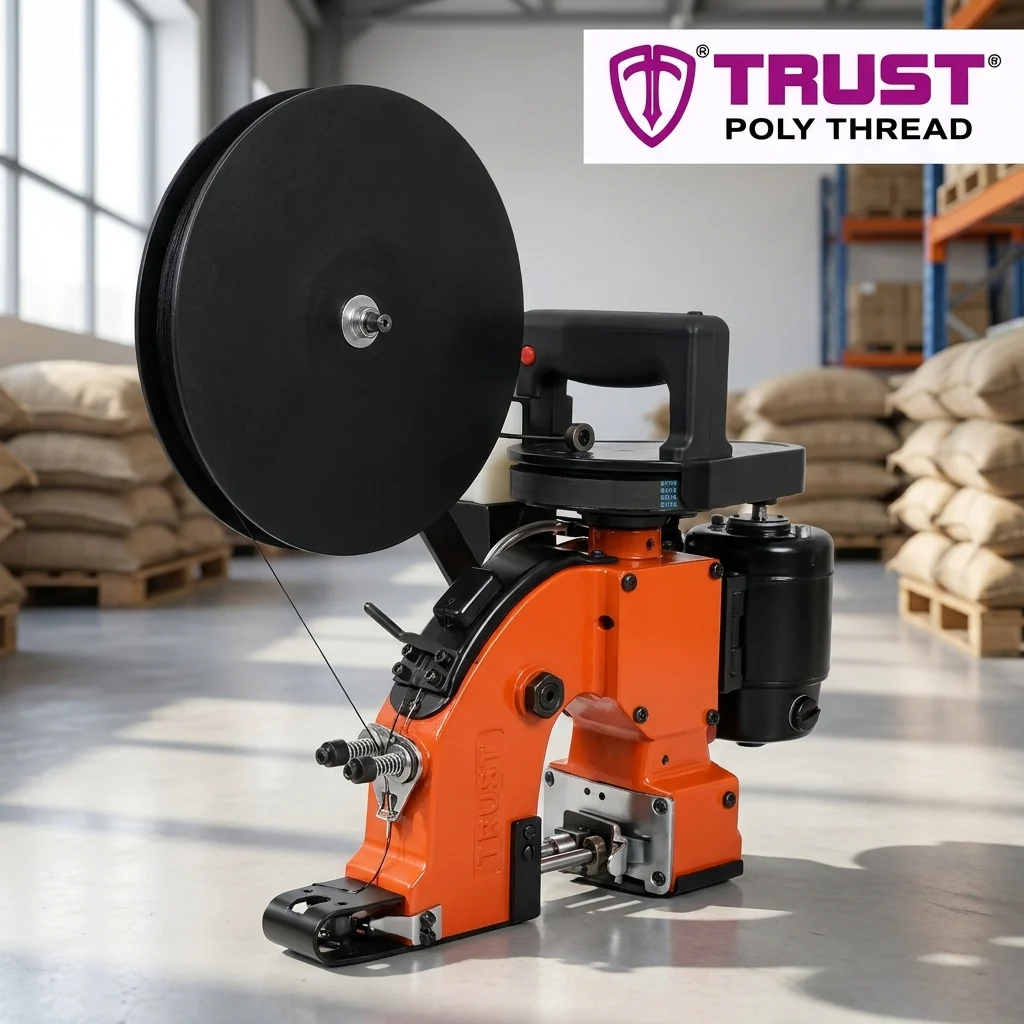
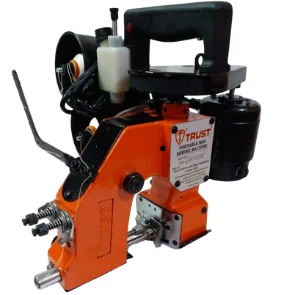
Portable bag closing machines are the ones most small and mid-sized units end up buying first. They're light, usually 4 to 12 kilos, motor or battery operated, and one person can carry one from sack to sack on a loading floor. If you're closing anywhere from a few dozen to a few hundred bags a day by hand, this is almost always the right starting point.
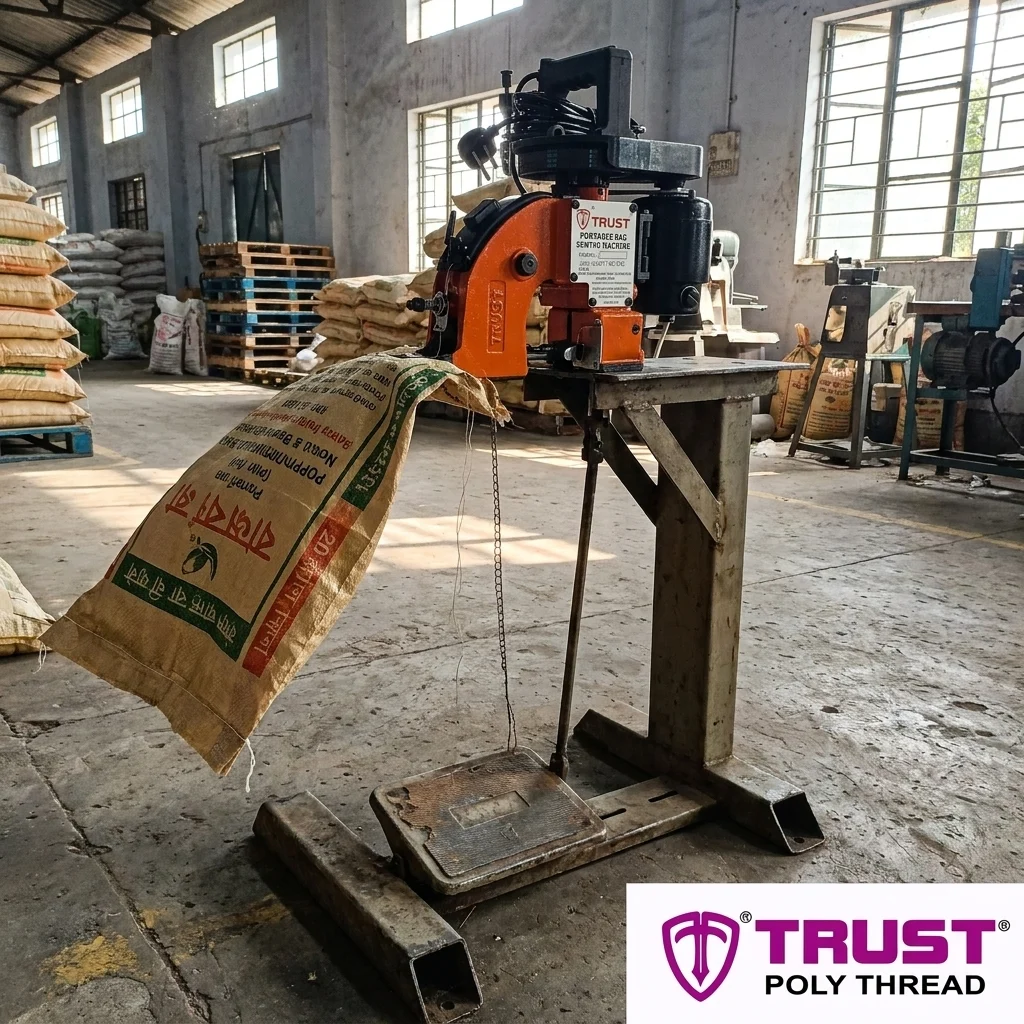
Foot-operated and pedestal machines sit on a stand. Both your hands stay free to hold and guide the bag. That speeds things up once volume climbs past what a hand-held unit can manage. These suit a fixed packing station rather than someone walking the floor bag to bag.
Then there are automatic machines, built for higher volume. A conveyor feeds bags past the stitching head. Nobody carries the bag to the machine anymore, it's the other way round. These make sense once you're running real volume daily, not occasionally. Buying one for light, irregular use is usually a waste of capital that would be better spent elsewhere.
Tell us your daily bag count and how your floor is actually laid out, and we'll say which category fits, rather than pushing whichever unit happens to be sitting in stock.
Who Actually Buys Which Type, In Our Experience
Most of the smaller rice mills we supply thread to run portable machines, often two or three scattered across a loading area rather than one fixed station. It suits how they work, since bags get filled and closed at different points on the floor depending on the day's volume. Larger mills tend to move to a pedestal setup once they've got one consistent packing point handling most of the daily throughput.
Tea packers are a slightly different case. A lot of their packing happens in a more controlled, fixed environment already, so pedestal machines tend to fit naturally even at moderate volume. The automatic, conveyor-fed end of the range is something we see mostly among larger flour and feed units running near-continuous packing lines, not the smaller operations that make up most of our regular buyers.
None of that is a rule. It's just the pattern we've noticed supplying both thread and machines to the same buyers over the years.
What Actually Matters When You're Comparing Machines
Sewing speed, usually quoted in stitches per minute, tells you how fast a single closing operation runs, but it only matters if your floor can feed bags to the machine that fast. A high-speed machine sitting idle between bags isn't earning its price difference.
Automation grade is really a simple question. Manual, semi-automatic or fully automatic, how much of the process still needs a person's hands? Voltage and frequency matter less for the machine choice itself and more for making sure your unit matches your shed's power supply, since 220V AC and 50Hz is standard across most of India but worth confirming rather than assuming.
Compatible bag material is the one buyers skip most often and regret later. A machine built for woven PP and HDPE sacks doesn't always handle jute or heavier gunny the same way. Run the wrong material through the wrong machine, and needles snap. Stitching skips too. Tell us what you're bagging before you tell us what machine you want, honestly, because the material should decide the machine, not the other way round.
| Machine Category | Optimal Daily Volume | Operator Requirement | Best Suited Application |
|---|---|---|---|
| Portable Handheld | 3 to 4,000+ bags/day | 1 Person (Hand-carried) | Flexible loading floors, scattered packing points |
| Foot-Operated / Pedestal | 3 to 4,000+ bags/day | 1 Person (Hands-free bag guiding) | Fixed packing stations, steady daily throughput |
| Conveyor Automatic | High-volume continuous lines | Line supervisor / Automated feed | Large mills & industrial feed packing plants |
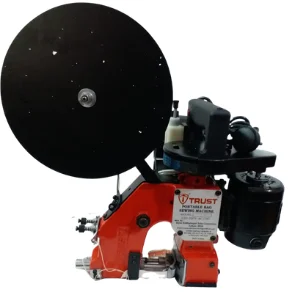
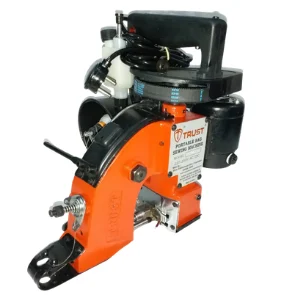
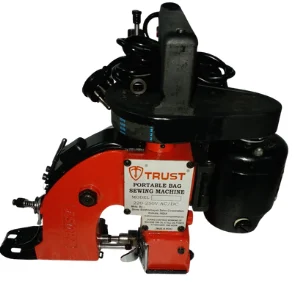
Supplied, Not Built By Us, And That's Worth Saying Plainly
We manufacture our own thread. Machines are different: we supply them, sourced from established machine makers rather than built on our own floor. We're not going to dress that up as something it isn't.
What we do bring to a machine order is the same thing we bring to thread: someone local who picks up the phone. Say a machine starts skipping stitches. Is it a tension problem, a needle problem, or a thread problem? When your machine supplier and your thread supplier are the same call, that question gets answered faster.
You can check our thread specifications directly for polypropylene thread and polyester thread to complement your equipment selection, alongside our rice bag sealing tapes.
Servicing And Spares, Which Matters More Than The Purchase Price
A machine that's ₹2,000 cheaper but takes a week to get a spare part isn't actually cheaper. Ask any mill that's had a stitching head down during peak season. We supply machines to the same buyers we supply thread to. So we hear about common faults early. Usually, we can tell you whether it's a known issue with a particular model, before you spend money guessing.
We'd rather talk you through a simple fix over the phone than sell you a whole new machine for a loose bolt.
How Ordering Actually Works
Tell us your daily bag volume, your bag material, and how your packing floor is laid out. We'll recommend portable, pedestal or automatic based on that, not based on what's easiest for us to source. For a first order, ask what after-sales support looks like before you commit, not after something goes wrong. Once confirmed, we dispatch from Kolkata, and if you're already ordering thread from us, it usually goes out together. Feel free to contact us to discuss your specs.
One Honest Note Before You Buy
Don't let a lower upfront price be the only thing deciding this. A cheap machine that jams every second shift costs you more in lost time. That loss adds up to more than the price difference ever saved you. Ask about after-sales support and spare parts availability before you ask about the price tag, and you'll usually end up choosing better anyway.
Questions We Get Asked About Bag Closing Machines
What's the difference between a portable and a pedestal bag closing machine?
Portable machines are hand-carried from bag to bag, light enough for one person to move around a floor. Pedestal or foot-operated machines sit fixed at one station, freeing both hands for handling the bag while a foot pedal runs the machine. Portable suits lower, scattered volume. Pedestal suits a dedicated packing point with steadier throughput.
How much does a bag closing machine cost in India?
Portable single-needle machines commonly run from around five thousand to fifteen thousand rupees. The exact figure depends on speed, build material and automation grade. Automatic, conveyor-fed machines cost considerably more, since they're built for continuous high-volume lines rather than occasional use. Tell us your volume and we'll quote against what actually fits, not the most expensive option available.
What sewing speed should I look for?
For most portable, manual-feed use, 2000 to 3000 stitches per minute is a common and sufficient range. Higher speeds mainly help once your floor can genuinely feed bags to the machine that fast, which usually means a pedestal or automatic setup rather than a hand-carried unit.
Do you supply machines for jute bags as well as woven PP sacks?
Compatibility depends on the specific machine and its needle and feed mechanism, not just the label on the box. Tell us your exact bag material, jute, woven PP, HDPE or otherwise, and we'll confirm rather than assume one machine handles everything equally well.
What voltage do these machines run on?
Standard is 220V AC, 50Hz, which matches typical Indian shed and factory supply. Battery-operated portable units are also available if your site has an unreliable power supply. Tell us your site conditions and we'll point you to the right option.
Is a battery operated machine better than a motor operated one?
Neither is universally better. Battery operated machines give you mobility where power access is patchy, but they need charging management on a busy floor. Motor operated machines run continuously without charge cycles but need a reliable power point nearby. It comes down to your floor layout more than the machine itself.
What's the GST rate and HSN code for bag closing machines?
Bag closing machines fall under HSN 8452, the sewing machine classification, alongside industrial and household sewing machines. This category dropped from 12 percent to 5 percent GST under the September 2025 reform. That's the same reduced rate our thread products now carry too, though the two started under different HSN chapters. Confirm the exact code with your accountant for your specific invoice, since classification can vary slightly by machine type.
Do you provide installation or training on the machine?
Basic setup guidance comes with every machine we supply, and we talk you through operation over the phone or WhatsApp if your team hasn't run one before. For anything more involved, tell us upfront so we can set the right expectation before you order rather than after.
What happens if the machine develops a fault after a few months?
Call us first. A lot of what looks like a machine fault is actually a tension setting, a wrong thread match, or a maintenance issue rather than the machine itself failing, and we can usually help sort out which one it is over the phone before you assume the worst.
Can I buy just the machine without ordering thread from you?
Yes. We don't tie machine orders to thread orders. That said, most buyers who do both find it convenient to have one supplier for the whole line, since a stitching problem is easier to diagnose when the same people supply the thread and the machine.
How many bags per day can a portable machine realistically handle?
It depends on your operator and floor setup more than the machine's rated speed, but a few hundred bags a day by hand is a realistic range for most portable units in regular small to mid-sized operations. Beyond that, a pedestal or automatic setup usually makes more sense.
Do you supply spare parts and needles separately?
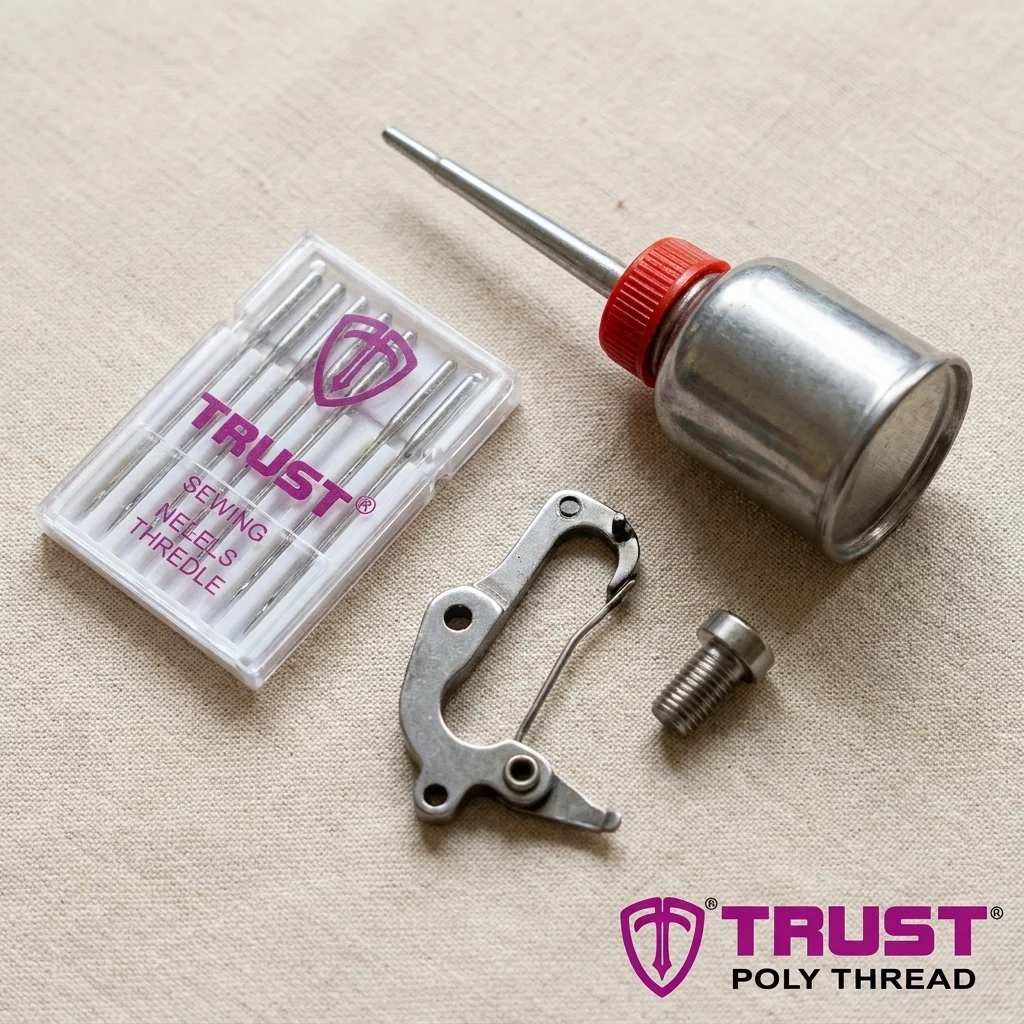
Yes, spares and needles can be ordered separately from a full machine, which matters since needles wear out well before the machine itself does. Tell us your machine model and we'll confirm what's compatible rather than guess.
Is a heavier or more expensive machine always the better choice?
No. A machine built for continuous high-volume lines is wasted capital if your actual daily volume is low and irregular. Match the machine to your real daily bag count, not to whichever unit sounds the most capable on paper.
Can I see a machine running before I commit to an order?
Ask us and we'll arrange a demonstration where that's practical, rather than asking you to commit based on a spec sheet alone, especially for a first-time buyer unfamiliar with a particular model.
Do you supply machines outside West Bengal?
Yes, dispatch is nationwide. Being Kolkata based mainly means shorter transit for buyers in the East and North East, but we don't restrict machine supply to any one region.
Which brands of bag closing machines do you actually supply?
We source from established machine makers rather than committing to one single brand, since the right choice depends on your speed, budget and bag material requirement. Tell us your requirement and we'll tell you plainly which maker's machine we'd recommend and why, rather than push whichever brand we happen to be sitting on.
How often does a portable bag closing machine need servicing?
It depends heavily on daily usage and how well it's kept clean of fibre dust, but as a rough guide, a machine running daily benefits from a basic check and oiling every few weeks, not just when something already feels off. Waiting for a fault to show up usually costs more than a quick preventive check would have.
Should I choose manual, semi-automatic or fully automatic for a mid-sized operation?
Semi-automatic is the common middle ground. It suits operations that have outgrown one hand-carried machine, but don't yet run continuous conveyor volume. Have an honest conversation about your actual daily numbers first. Overbuying wastes money one way. Underbuying wastes it another way.